 The Shift
Budget 2026 is the most serious federal commitment to non-market housing in decades. It aims to triple non-market starts to 24,000 a year, raises Build Canada Homes’ total capital to $45 billion, puts public land toward housing, sets aside 10 percent for Indigenous housing, and funds the purchase of existing rentals through the Rental Protection Fund, which can take homes out of the speculative market. Budget 2026 commits to putting the government on a path to end homelessness within ten years, backed by $11.2 billion over the first four years, an indication that they have listened to the demands from human rights advocates calling for firm commitments with measurable goals and timelines. For most households in Canada, the cost and insecurity of housing is the number one issue in their lives, and the language in this budget seems to reflect an understanding of their reality.
But on a closer look, there are clear fault lines in the budget. Most notably, it was not drafted using a human rights framework, despite Canada’s international obligation and its commitment to realize the right to housing in the National Housing Strategy Act. Instead, the budget espouses the same trickle-down, supply-side logic that has already failed the Canadian housing system. How public dollars are deployed makes clear who and what is being prioritized. By the government’s own accounting, two-thirds of all new spending in this budget, $98 billion, goes to growth and investment, while only one-third, $48 billion, goes to people, and that third still has to stretch across health, childcare, groceries, and housing together. A single corporate tax break, the $36 billion Productivity Mega Deduction, is more than double everything the budget newly commits to housing and homelessness combined, roughly $16 billion over five years. Military spending, already on a funded path from 2 toward 4 percent of GDP, runs into hundreds of billions over the same period, tens of dollars for every dollar of new homelessness funding.
Instead of shaping the housing system, this budget shows that the government sees its role as correcting a small portion of market failures while incentivizing the coven that profits from our homes, what we call Housing, Inc. A government truly committed to addressing the housing and homelessness crisis would put forward a bold budget willing to disrupt the status quo and reclaim housing as a human right, not an asset.
It is critical for the government to get this right, not just for everyone in Canada, but also to secure its own political success. Popular movements demanding the right to housing and true affordability are exploding around the world, not least in Spain, France, Germany, and even the United States, and they are bringing political change with them. That momentum is building in Canada too. The Shift has spent the last three months travelling across the country, coast to coast to coast, and we have heard and felt the growing discontent and outrage at our governments’ willingness to prioritize corporate interests in the face of rising homelessness, unaffordability, and insecurity. The demand for real solutions and accountability is building, and the government would be wise to take it seriously by ensuring that the current and future needs of individuals and families in Canada are met on a priority basis, starting with the most vulnerable.
Homelessness
A commitment to end homelessness without a strategy that confronts the systemic drivers causing people across the country to lose their homes, is set up to fail. Whether homelessness rises or falls depends on the balance between how many people lose their housing and how many are housed. This budget spends almost entirely on housing people out of homelessness and almost nothing on preventing them from falling into it. There is no ban on evictions into homelessness, no prevention program, and nothing required of the landlords whose rent increases and evictions push people out. People will keep becoming homeless faster than these programs can house them. A ten-year target without prevention and without market regulation will not reach zero.
The budget also underestimates and misdiagnoses the problem. It asserts that roughly 65,000 people are living in homelessness in Canada, a figure drawn from point-in-time counts that leave out hidden homelessness: people living in cars or couch surfing, many of them women, children, youth, refugees, and migrants. On that undercount, it builds a plan aimed at the homelessness we encounter daily, people living with mental health and addiction issues, describing the problem as gaps across housing, health, mental health, and addictions. But homelessness is not mainly a health or addictions problem. Research from the Canadian Alliance to End Homelessness shows that homelessness rose most in the communities where the lowest-cost rental housing became more expensive and harder to find, while conditions in the rest of the rental market had no significant effect. Health and addictions can shape whether a given person loses their housing, but they do not explain why homelessness has doubled since 2018 or why some communities are hit far harder than others. That is driven by the loss of deeply affordable housing, the product of policy choices, above all the choice to treat housing as a commodity. A plan that treats homelessness solely as a health crisis will fail to address the systemic nature of the crisis. If you want to address homelessness, you have to change the system that keeps profiting from our homes.
Financialization of Housing
For years we have been told that housing affordability will be restored if we deregulate, build enough market supply, and attract enough investors. It has not. Prices rose, rents increased, financial investors took a growing share of the housing stock, and homelessness and unaffordability reached record levels. These are the consequences of a financialized housing system. More of the same model will not produce a different result.
It is possible that untethered investment incentives and lighter regulation support growth in some parts of the economy. Housing is not one of them. Investment and deregulation have not built a system that meets housing need. They have built one that meets investor returns.
This budget does not only insulate financialization, it underwrites it. It takes on risk for private capital through $32 billion in construction loans, GST rebates on new rentals, private mortgage insurance for buildings of 5 to 50 units, and cuts to fees and development charges. All of it is done without embedding any conditionalities for the production of truly affordable homes. There is no public value expected for public dollars given. The budget’s economic centerpiece, the Productivity Mega Deduction, gives investors the lowest tax rate on new business investment in the G7, cutting the effective rate on new investment from 13 to 6.4 percent, with no condition tying that subsidy to affordability or to the right to housing.
New Solutions
There is a more effective and less expensive approach than subsidizing market supply that never reaches the people who need it. The Shift is setting out a policy suite that would make investors, pension funds, banks, and corporate landlords part of the solution, on terms that serve housing need. Some of the solutions we are crafting include:
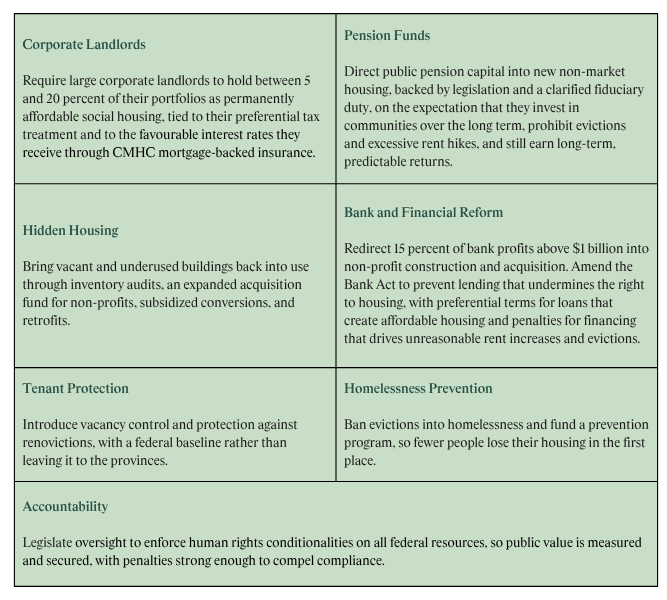
These measures use the capital and the buildings Canada already has at lower cost than subsidizing new market supply, and in some cases with the capacity to generate revenue.
The Choice Ahead
Budget 2026 proves there are federal resources available. The government found $36 billion for a single corporate tax deduction and hundreds of billions for defence. The constraints on ending homelessness and addressing the housing crisis do not revolve around fiscal capacity, but rather the political will to uphold its human rights obligations and its commitments to the electorate.
A government serious about that right would not simply try to address market failures while leaving the housing market intact. It would regulate the actors driving unaffordability, attach public-interest conditions to every public dollar, and build the non-market housing the market will never deliver on its own.
The will to act is no longer optional. The movements demanding housing as a human right are growing, here and around the world, and they are reshaping politics as they go. The government can keep underwriting Housing, Inc., or it can choose the people it was elected to serve.